Instructions
2026
This assignment asked us to write a set of instructions that would explain a complicated process while being clear, separating tasks, and using visuals. I chose a topic I am very familiar with, art, and used my drawings for demonstration while explaining what I did.
How to Draw a Simple Scene Step-by-Step
Introduction
Step 1: Blocking Out Shapes


Humans and Animals

Plants and Landscapes


Step 2: Creating an Outline
In this tutorial, beginners will observe a reference image, and learn how to draw simplified people, animals, plants, and landscapes using basic design principles.
Here is the example image we will work off:
We must first break down the shapes that make up the image. A good example of this is the stick figure. It reduces the human form into 6 parts. This could include: a circle and 5 lines, or a circle, a rectangle, and 4 lines.
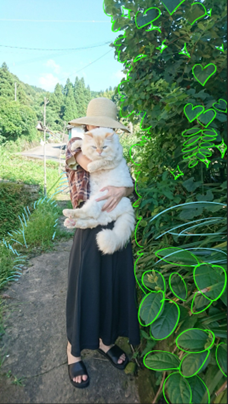
To start, we can trace the circle and oval shapes of the subjects in the foreground1, which include the heads and torsos. Then we can do the same for squares or rectangles, which are usually best to block out limbs. Living subjects can usually be broken into these 4 shapes. Next, we will move on to the background2.
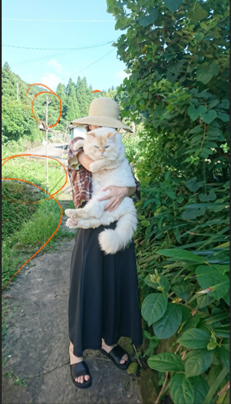
Even though there are a few non-plant objects in the background, we will only focus on the plants. There are 2 shapes that stand out: triangles and ovals. Almost every tree along the horizon line is an isosceles3 triangle. The patches of grass, bushes, and trees that remain are circular.
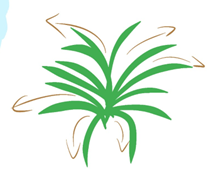
On the left side of the picture, there are plants that grow out straight like stems, but are in bunches. It helps to think of them as fireworks, or as arrows without tips that point outward from the center.
On the right, there is a tall bush spanning the bottom of the picture to the top. This would be a lot of detail to capture, but we are only going to find and draw the shapes that stand out most.
We can see it’s made up of several leaf shapes, including ovals, hearts, and lines.
Instead of trying to capture every individual leaf in the bush, we are going to simplify it by drawing the outline of the entire bush, separate it into a few groups by type of plant, and reduce it down to a few leaves for each type.
You can also decide to outline and include the gaps between the leaves that reveal the sky, but that is your personal choice, and I won’t show you that in the final product.
Now we’re going to draw on our own canvas[1].
Now that you’ve found the basic shapes, it's time to make them look more real. Draw lines around the shapes to group them and connect the lines.
Here are some tips to line each subject:
-
When you are outlining heads, create two rounded corners at the bottom to look like a jaw.
-
When you are drawing the oval-shaped leaves on the bush, make them overlap. In nature, leaves don’t separate themselves and grow from stems right next to each other.
-
When you are outlining the triangular trees and bushes in the foreground, use either one of the line patterns shown in the image below.
The trees with less detail can use the more uniform4 line (pictured on the right side), but it is better for the bush in the foreground to have some variation. How I like to do this is alternate throughout the line: 1 big arch, 2 little arches, and 1 big arch, 1 little arch.
Erase the lines you wouldn’t see in the actual photograph, like the lines between the upper and lower arm. Also make sure to round the edges of feet, hands, and paws to soften them.
This is the time to fix up anything that doesn’t look right and add the small details.
A few of the additions I made include:
-
An extra oval for the rim of the sunhat
-
The cat’s ears, eyes, and nose (made with triangles, semicircles, and lines respectively)
-
Circles and a heart to make the cat’s paw pads
-
Lines separating the fingers and toes
-
Triangles for the pleats of the skirt
-
An oval around the arm for the shirt sleeve
-
Rectangles for shoe straps
-
Lines for power wires, sticks, and grass stalks
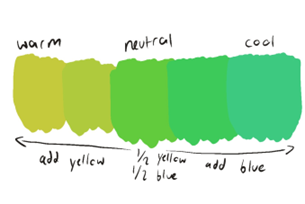
Use your reference to figure out what colors to use. However, to get a more accurate final product, it helps to know the difference between warm and cool colors.
Warmer colors give the impression of hot or dry climates but can create a cozy mood. Cool colors match colder climates but can make viewers feel energized. The reference photo shows neutral and cooler greens, so choosing something on the blue side of the color wheel is best. Color all areas in flat colors since we will not be focusing on shading in this tutorial.
When you are filling in backgrounds that use large amounts of the same color, use more saturated5/ darker shades in the front and use less saturated/ muted colors as you fill the plants that are further away. This is done by adding black for darker shades, and white for lighter. This creates the illusion of distance.
Now the last step is to clean up the piece by making one clean outline and coloring the inside of it.
We won’t use black to outline because it can be too high of a contrast6 for a peaceful scene like this. Instead, take the color of each item and choose a slightly darker shade to outline it: e.g. dark brown for the shirt, and sandy yellow for the cat. It just needs to be dark enough to stand out from the inside color.
The grass areas should be the only parts that don’t have a solid outline. They will follow the directions from the “detailing plants” subsection, since this makes them look less rigid.
And that is all! Congratulations on creating an art piece that includes living subjects, plants, and landscapes. You can now apply this process to your future projects using any reference.
You can continue to add details, shadows, highlights, and more to your scene, but you have completed the objective for this tutorial. You made your own drawing, without tracing, that resembles the image. It’s okay if this doesn’t look professional the first time. Practice is the #1 way to improve, so keep trying.
For this tutorial, I used an iPad, Apple Pencil, and the drawing program Procreate. However, you do not need expensive tools to complete the instructions. People who are just starting out don’t usually own expensive materials and may not want to buy them. This tutorial can be done with any piece of white paper, a pencil, and colored pencils, crayons, or markers. Although, in the case of using physical materials, it may be helpful to print out the reference image.
Foreground Parts of an image that are closest to the person viewing it
Background Parts of an image that are furthest from the person viewing it
Isosceles Having 2 sides of equal length that are longer than the 3rd side of a triangle
Uniform Unchanging or not varying
Saturated Color that has not been mixed with white
Contrast The difference between opposing features; used to create emphasis
[1] Note: You are allowed to trace, for all of these shapes. It is recommended by many artists, and it is an important part of the learning process. However, make sure to give credit to the original creator of an art piece if you are tracing their work to learn, especially if you are going to show your finished product publicly.

Step 4: Final Line Art and Clean Up

